Fault Injector for Autonomous Quadrotors
Introduction
The thesis includes a comprehensive literature review to establish a theoretical framework for improving UAV failure prediction, examining current UAV capabilities, sensor technology, and the application of digital twins in failure detection and predictive maintenance.
Objectives
- defining and characterizing the quadcopter and its environment,
- identifying and characterizing failure scenarios, and
- creating a fault model encompassing generic and quadcopter-specific faults.
The end goal is to implement these faults using a tool that manages their presence in the code.
Approach
While the original plan included a risk analysis of the faults, it was later discarded due to its perceived misalignment with the practical nature of the work. It is also noted that depending on the complexity of implementing exploits, it may not be possible to implement all identified faults. The project intends to perform experiments related to system assessment in an organized and efficient manner.
The research approach involves:
- identifying all components of an autonomous quadrotor,
- building a representative model,
- selecting appropriate simulation software, and
- creating a fault model.
The fault model is developed by analyzing software modules for potential exploitation. The document then describes the conceptualization of a fault injection tool using a web-based prototyping tool (Figma) and its subsequent implementation using Qt Creator.
The implementation phase involves working on both the tool's interface and the incorporation of specific faults, primarily focusing on GPS faults. The final step includes performing experiments to validate the implemented elements and analyzing the results to draw conclusions about the tool's effectiveness.
Methodology
The flight-controller stack used is the PX4-Autopilot stack, and the simulation environment is Gazebo. This is preferred due to the light-weight and open-source nature of both. PX4's robotics friendly middleware that facilitates communication with the flight-controller stack and companion systems was attractive. Gazebo's wide array of sensor implementations were attractive for this.
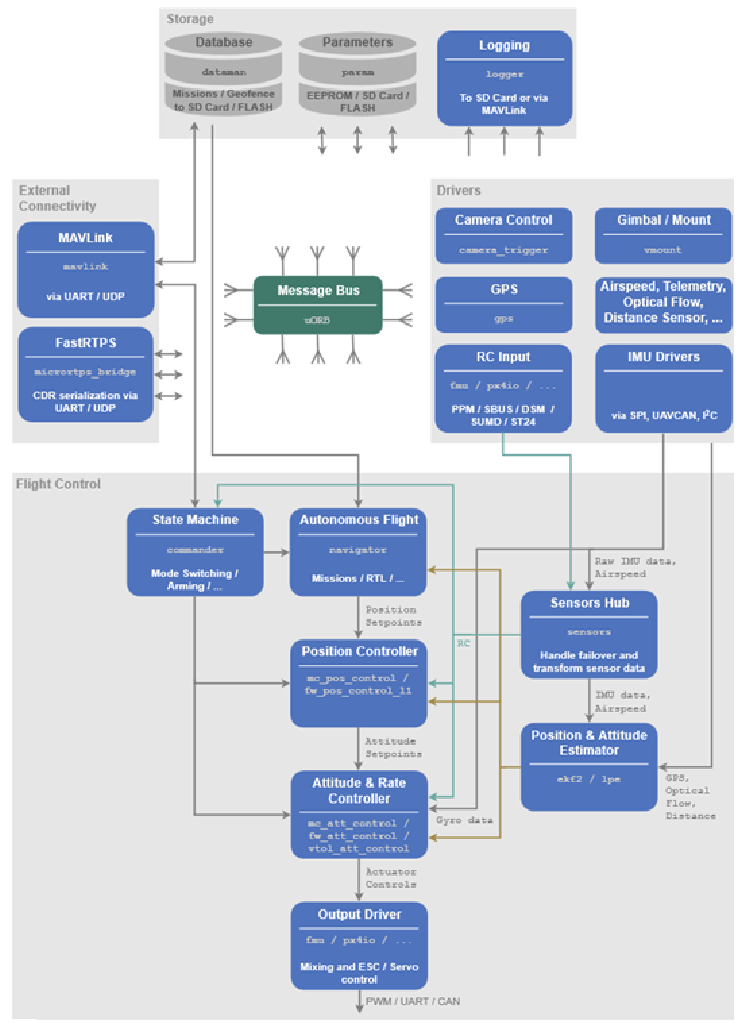
The PX4's internal firmware architecture is defined as in the following image. (NOTE: there are changes with the newest version of PX4 firmware as there is a shift towards the MicroXRCE-DDS firmware over the previous methodology).
The report defines 6 kinds of faults that can potentially injected into the
system.
- Communication faults: faults that target the MAVLink communication channel between PX4's MAVLink module and its respective ROS node.
- Command faults: faults that target commands issued by the State Machine module (e.g. abort command).
- Environmental/Sensors/PS faults: faults that target the data gathered by the sensors and corrupt it.
- Mission faults: faults that target the mission on cache whilst it is being read, possibly affecting trajectory.
- Sensors/PS data transformation faults: faults that target the data gathered by the sensors whilst it is being processed.
- Estimator faults: faults that target the processed data once it is sent to the modules that control the drone's movement.
These faults can potentially be implemented as follows:
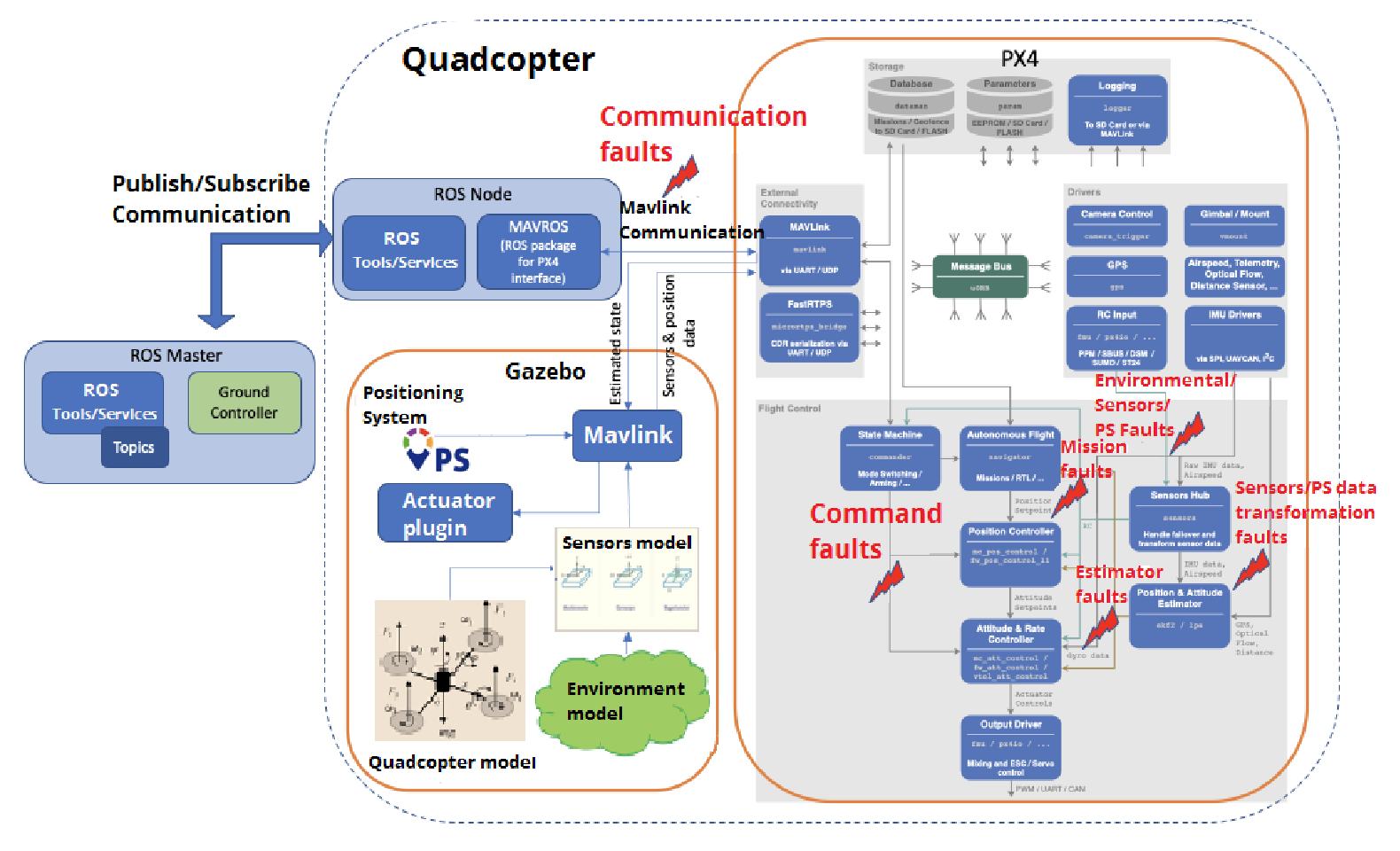
Although the report lists a range of methods to implement faults, it limits its work to the GPS module in order to map and observe the behaviour before, during and after fault injection. The test cases were for Freeze, Delay and Fixed type faults. This is implemented in the code (from Line 885) as follows:
if(fault_mode == 1 && !std::isnan(start_injection_time) && !std::isnan(end_injection_time) && (gps.timestamp - takeoff_start_timestamp >= start_injection_time) && (gps.timestamp - takeoff_start_timestamp <= end_injection_time)){
   //Fixed Value
   PX4_INFO("injecting gps fixed value");
   ifisnan(injected_gps_lat))  gps_output.lat = (int32_t injected_gps_lat; else gps_output.lat = gps.lat;
   ifisnan(injected_gps_lon))  gps_output.lon = (int32_t injected_gps_lon; else gps_output.lon = gps.lon;
   ifisnan(injected_gps_alt))  gps_output.alt = (int32_t injected_gps_alt; else gps_output.alt = gps.alt;
}else if(fault_mode == 2 && !std::isnan(start_injection_time) && !std::isnan(end_injection_time) && (gps.timestamp - takeoff_start_timestamp >= start_injection_time) && (gps.timestamp - takeoff_start_timestamp <= end_injection_time)){
   //Freeze Value
   PX4_INFO("injecting gps freeze value");
   injected_gps_lat = gps.lat;
   injected_gps_lon = gps.lon;
   injected_gps_alt = gps.alt;
   gps_output.lat = injected_gps_lat;
   gps_output.lon = injected_gps_lon;
   gps_output.alt = injected_gps_alt;
   hasFreezeValue = true;
}else if(fault_mode == 3 && !std::isnan(start_injection_time) && !std::isnan(end_injection_time) && (gps.timestamp - takeoff_start_timestamp >= start_injection_time) && (gps.timestamp - takeoff_start_timestamp <= end_injection_time)){
   //Delay Value
   //Wait for delay_value seconds
   PX4_INFO("injecting gps delay value");
   gps_output.lat = gps.lat;
   gps_output.lon = gps.lon;
   gps_output.alt = gps.alt;
   std::this_thread::sleep_forseconds((int)delay_value);
}
else{
   gps_output.lat = gps.lat;
   gps_output.lon = gps.lon;
   gps_output.alt = gps.alt;
}
The second half of the report defines a prototype UI that can be used to inject the faults into the system.
PX4 contains various failsafes that allow it to detect anomalies internally and abort flights that exhibit said anomalies. In this experiment, the failsafe activation delays were set to minimum. Conclusion
First off, although the failsafe delay was set, any sudden changes in values was met with an immediate abort command.
The report concludes that the initial objectives were met, with the behaviour of simlated drone under fault matching expected hypotheses. However, there is still room for improvement as not all faults were implemented.
Evaluation
This report, while extensive in its set-up, falls during the implementation stages significantly. The testing is insufficient to conclude that the objectives are met. It is suspected that a time-crunch or resource-crunch resulted in this level of output. Nonetheless, even with this shortcoming, it offers a pathway to feasibly inject faults into the UAV system for testing SRTA use cases.
First off, the injection of fault for GPS is hardcoded into the firmware, requiring recompilation everything a new type of fault is expected to be injected. To fix this, relying on the internal system parameter server is considered. Changing the values in the server for params corresponding to fault types can make the fault testing more dynamic in nature.
Secondly, we can refer to the listed fault classes and expand it by also adding a category called Use Case class that refers to the type of use case a potential fault can fall under. A rough example list could be: Security Attack, Sensor Failure, Controller Failure, Software Failure, etc.
This can then be put in tabular form like this:
| Fault Title | Fault Class | Use Case Class |
|---|---|---|
| Target and alter data retrieved from sensors | Environmental/Sensors/PS faults | Security Attack/Sensor Failure |
| Alter published flight control output signal values | Sensors/PS data transformation faults | Software Failure/Controller Failure |
| Intercept and alter mission commands and mission signals | Mission faults | Security Attack |
| Target middleware that facilitates communication between controller-processor/drone-drone/drone-GC etc. | Communication faults | Security Attack/Software Failure |
| Target and alter calibration of the internal controller | Estimator faults | Controller Failure/Software Failure |
| Confound the internal state machine that maintains transition between flight modes and states | Command faults | Software Failure/Controller Failure/Sensor Failure |
Finally, observe that most, if not all, of the faults in the thesis are targeting the flight control modules within the firmware instead of the environmental models, sensors models, or quadcopter models in the simulated environment. This has its advantage as the firmware is simulator independent and can be run on different simulator types. However, this also means that HITL testing with the firmware can get sketchy as additional memory and internal clock interruptions are potentially being introduced that will affect the hardware's runtime behaviour.