DrEureka: Language Model Guided Sim-To-Real Transfer
Introduction
It is about transferring the policies learned in simulation to the real world.
Sim-to-real approaches rely on:
- manual design.
- tuning of the task reward function as well as simulation physics parameters.
Process is slow and human-labour intensive.
This is LLM-guided sim-to-real approach --> Requires only physics simulation for target task.
Automatically constructs suitable reward functions and domain randomisation distributions to support real-world transfer.
Demonstrated with quadruped locomotion and dexterous manipulation tasks.
Showcase approach in:
- quadruped balancing
- quadruped walking atop yoga ball
Process
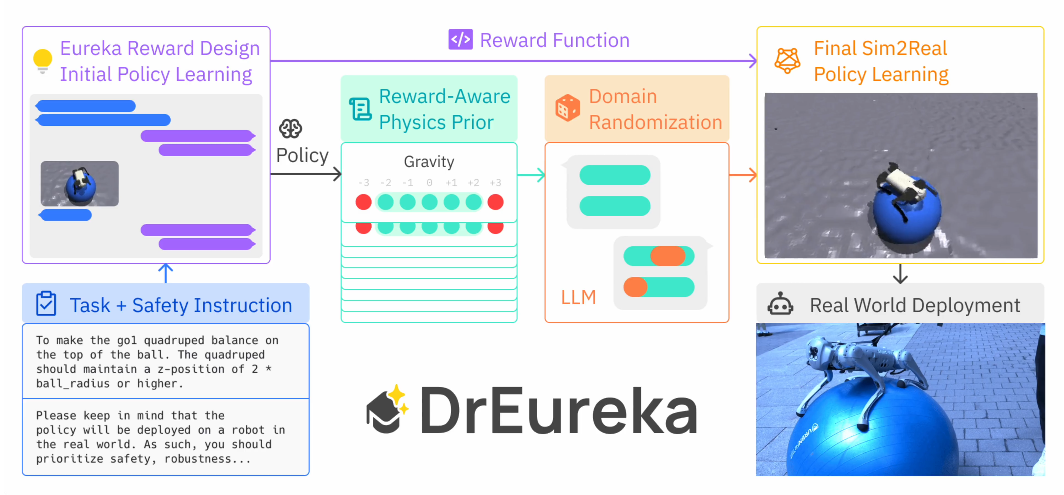
To generate regularised reward function and policy, DrEureka:
- takes task and safety instruction,
- environment source code.
Tests policy under different simulation conditions to build reward-aware physics prior --> LLM generates set of Domain Randomisation parameters (DR).
Trains policies for real-world deployment using synthesised reward and DR parameters
Experiments
DrEureka evaluated against 3 tasks:
- Quadruped globe walking,
- Quadruped locomotion,
- Dexterous cube rotation,
Uses GPT-4 as backbone LLM.
Eureka hyperparameters are used for reward generation before sampling 16 DR configurations.
Baseline is human designed.
Results
Comparison to pre-existing sim-to-real configurations
DrEureka able to outperform Human-Designed in forward locomotion.
For rotation also it outperforms.
Task permits very little room for error, thus policy either perform very well or extremely poorly.
Real-world robustness tested by placing quadruped in different testing environments:
- Default - lab
- Grass - lab
- Sidewalk - world
- Socks - lab
Method remains performant or outperforms human-designed.
DrEureka does not need a reward curriculum.
Safety instruction enables safe reward functions.
DrEureka reward qualitatively differs:
- Multiplicative instead of additive.
- More stringent penalties if safety terms are violated.
Efficacy of DR configurations
DrEureka surpasses DR optimisation baselines.
It uses physical reasoning to construct DR ranges.
Conclusion
All in all, DrEureka showed stable performance in sim-to-real transfer learning.
Shows ability of robots trained with this method to perform tasks that aren't originally part of training set and are generally complex (walking on globe)